Beyond Your DNA: 5 Surprising Truths Your Body’s Chemistry Is Telling You Right Now
For decades, we’ve been told that the secret to our health lies in our DNA. Our genes are the fundamental “blueprint”—the architectural plan that dictates everything from our eye color to our predisposition for certain diseases. But what if that’s only the beginning of the story?
Imagine your DNA is the architect’s blueprint for a skyscraper. It’s essential, but it can’t tell you about the flow of electricity, the traffic in the elevators, or the conversation happening in the boardroom on the 45th floor right now. To understand that, you need a live operations report. That’s what metabolomics offers—a real-time dashboard of your body’s bustling, moment-to-moment activity.
——————————————————————————–
1. Your Genes Are the Blueprint, But Your Metabolites Are the Live Report
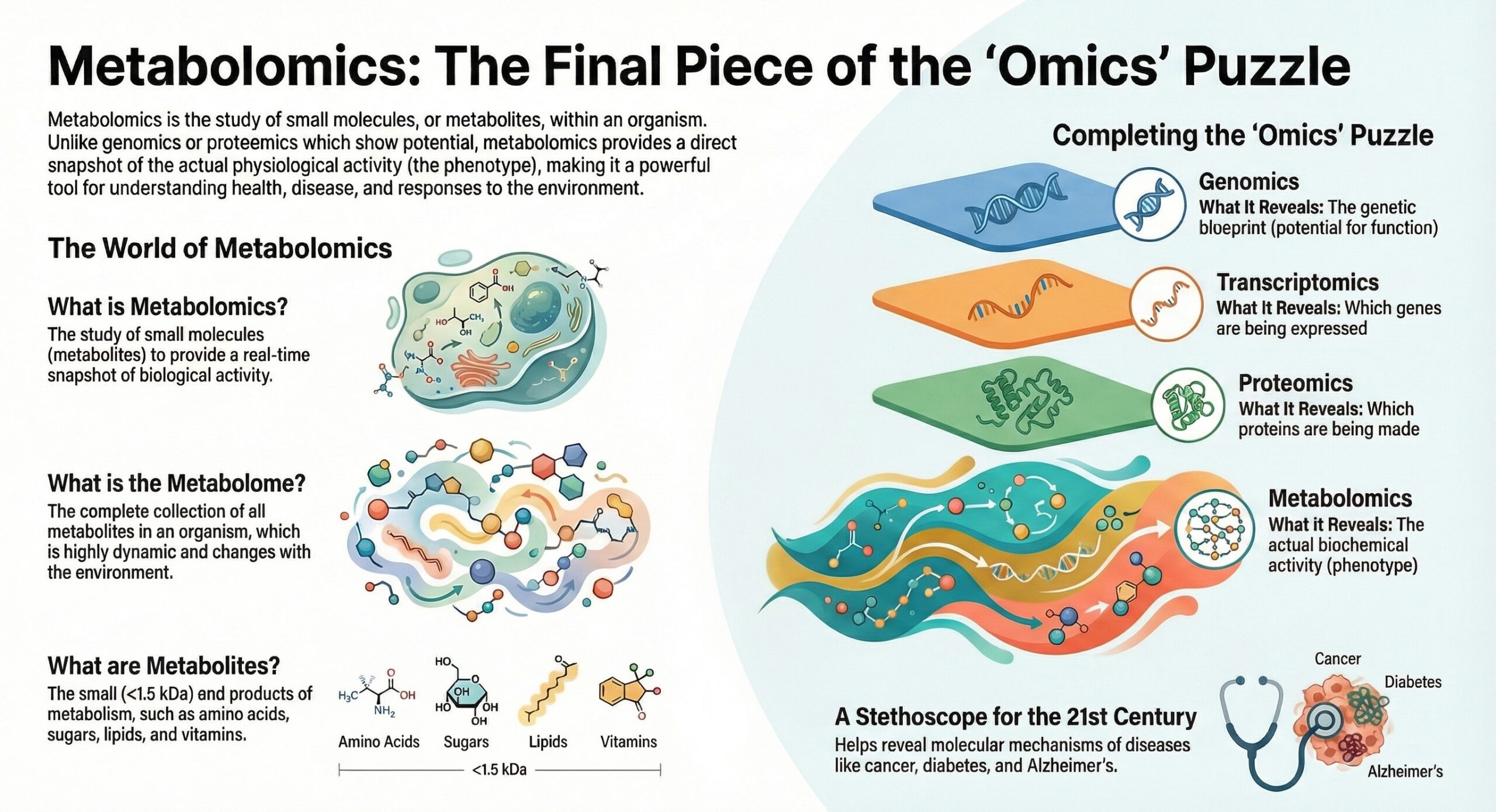
Metabolomics is the study of the metabolome—the complete collection of small molecule metabolites in a cell, tissue, or organism. Think of it as a direct “fingerprint of cellular biochemistry.” It measures things like amino acids, sugars, and fatty acids to give a snapshot of your body’s current physiological state.
This stands in sharp contrast to genomics. An analogy from researchers helps clarify the difference: if genomics can identify a tree as an apple tree, metabolomics can tell you about the apple’s flavor profile, its antioxidant levels, and how specific weather patterns influenced its growth.
This gets to the heart of the difference between your genotype (the genetic blueprint) and your phenotype (the observable characteristics determined by genetics and the environment). Metabolomics provides a deep look into the phenotype, turning the static blueprint into a dynamic, live report. This isn’t just an academic distinction; it’s the difference between seeing health as a predetermined fate and seeing it as a dynamic process we can actively understand and influence every single day.
——————————————————————————–
2. You’re Not Just You—Your Metabolome Is a Team Sport
It’s natural to assume that the chemical signals in your body are produced solely by your own cells. But one of the most surprising truths revealed by metabolomics is that our internal chemistry is a collaborative effort, a real-time report fed by multiple sources.
This chemical conversation includes signals from our own cells, of course, but it’s also profoundly shaped by the food we eat (dietary sources) and the medications or environmental compounds we’re exposed to (xenobiotic sources). Most surprisingly, a huge part of the dialogue is driven by our host microbiota—the trillions of microbes living in our gut that produce their own vast suite of metabolites, powerfully influencing our health. This reveals an incredible interconnectedness, showing that our health is a constant dialogue between our cells, our resident microbes, and the world around us.
——————————————————————————–
3. Lipids Aren’t Just ‘Fat’—They’re a Critical Field of Study
When we hear the word “lipid,” most of us just think “fat.” But in the world of metabolomics, lipids are so important that they’ve earned their own dedicated branch of study: lipidomics.
Researchers realized that studying the broader metabolome and proteome (the set of proteins) wasn’t always enough to understand complex diseases. This realization was so profound that by 2005, researchers in Nature Reviews Drug Discovery noted that “more and more studies show a direct link between lipids and many diseases, and that metabolomics and proteomics studies are no longer sufficient to provide a clear picture of the causes of these diseases.”
We now know that abnormal lipid metabolism is linked to a host of conditions, including obesity, atherosclerosis, and diabetes, but the implications don’t stop there. Metabolomics has revealed abnormal metabolic pathways are a hallmark of numerous cancers and are even implicated in neurodegenerative conditions like Alzheimer’s disease. This elevates a commonly oversimplified molecule to its rightful place as a complex and vital component of health, one that demands its own dedicated scientific field to fully understand.
——————————————————————————–
4. Getting a Clear Picture Is a Herculean Data Task
Generating these profound insights isn’t as simple as running a blood sample through a machine and getting an answer. The process is a testament to scientific rigor—a form of biochemical forensics where “careful data processing and statistical analysis are required to derive useful and reliable information from these profiles.”
First, scientists act like crime scene investigators, using ultra-sensitive techniques like Mass Spectrometry (MS) or Nuclear Magnetic Resonance (NMR) to detect thousands of molecular “clues” in a sample—many of them in vanishingly small quantities.
Next comes preprocessing, which is like cleaning up the evidence. They digitally filter out background noise, identify the true signals (or “peaks”), and correct for tiny variations, ensuring every clue is pristine and reliable.
Finally, with clean data, the real detective work begins. Statistical analysis, using everything from simple comparisons to powerful machine learning algorithms like Random Forest, allows them to find the meaningful patterns—the “smoking gun” metabolites that distinguish a healthy state from a diseased one. These insights are hard-won conclusions extracted from an immense amount of complex data.
——————————————————————————–
5. The Biggest Answers Lie in Connecting All the Dots
While metabolomics is an incredibly powerful live report, its ability to provide an exhaustive description on its own is limited. The true future of biological research lies in connecting it with other fields in an approach called “multi-omics.” The most comprehensive understanding comes from integrating metabolomics with genomics, transcriptomics, and proteomics.
Think of it as assembling a complete picture of a factory’s operations. Genomics provides the original factory blueprint. Transcriptomics shows which parts of the blueprint are being copied into daily work orders. Proteomics reveals the machines and workers actually built to carry out those orders. And Metabolomics? It’s the live report on the raw materials being used, the products being made, and the waste being generated. Only by looking at all of them together can you truly understand if the factory is functioning as it should. This integrated approach provides a truly holistic view of health and disease.
——————————————————————————–
Conclusion: Are You Listening to Your Body’s Conversation?
Metabolomics represents a fundamental shift in how we view our health—moving from the static, unchanging code of our DNA to the dynamic, real-time chemical conversation happening within our bodies. Your metabolome captures the interplay between your genes, your diet, your lifestyle, and even the tiny organisms that share your body.
The science is complex, but the message is simple: your genetic blueprint is only the first page of your health story. The rest is written every day, every moment, in the dynamic language of your metabolism. If your body’s chemistry is broadcasting a live report every second, what could you learn by finally starting to listen?